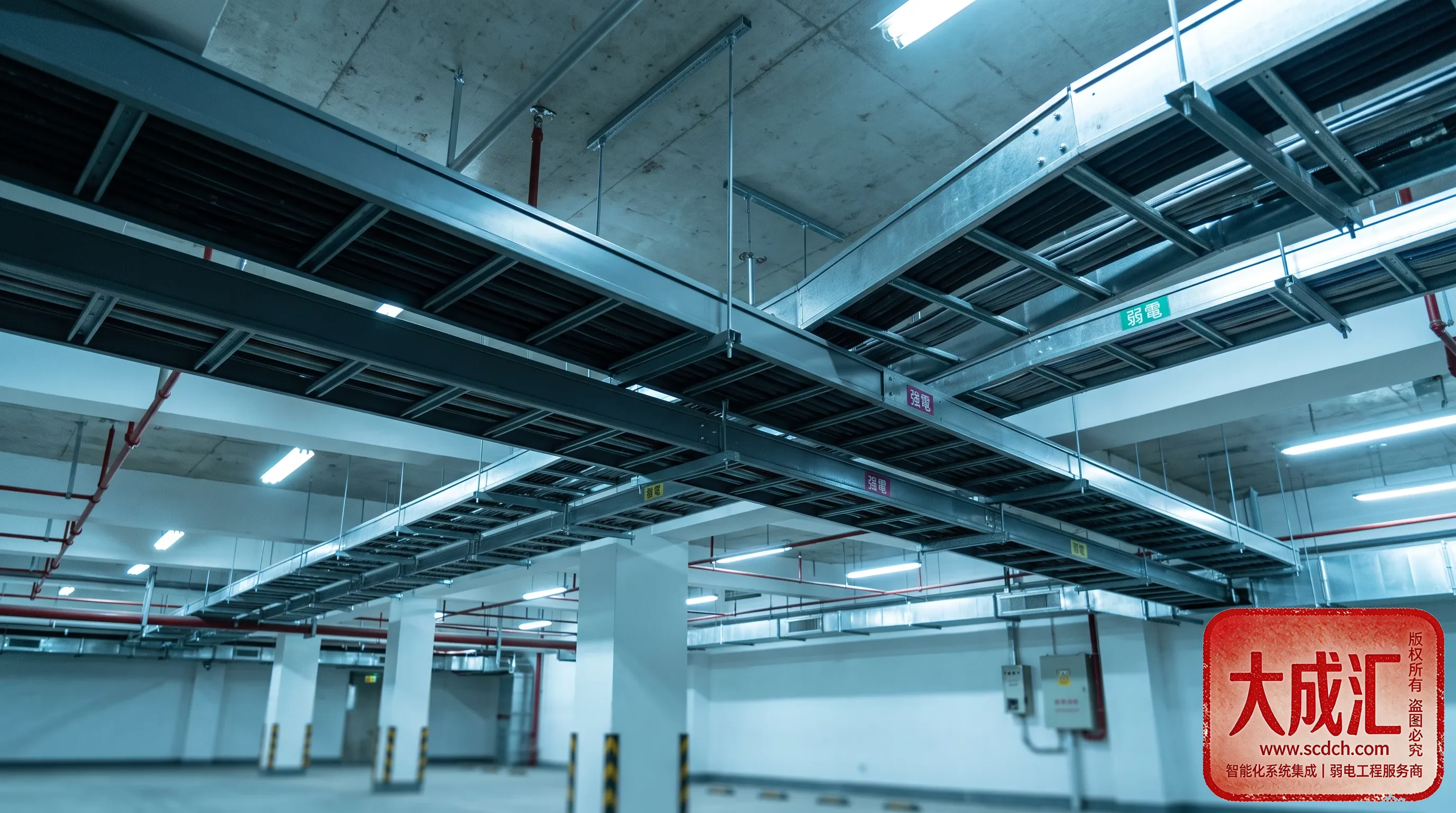
Integrated Conduit and Cable Tray Installation
Power and signal cables laid in separate, orderly, secure channels for a clean and reliable intelligent building.
Integrated conduit and cable tray installation is a systematic cable routing project for intelligent building systems. Sichuan DCH Technology (DCH) relies on more than 10 years of experience in weak-current engineering and construction management to provide end-to-end delivery — from design, material selection and concealed work acceptance to installation, testing and handover — covering power conduits, signal conduits, cable trays and trunking in a unified and standardized way, so that every meter of cable route is "orderly in layout, safe in separation and traceable in maintenance."
1. Background and Value
In intelligent building projects, weak-current and strong-current systems are numerous and their cabling routes are complex. Problems such as mixed laying of strong and weak current, cluttered ducts and unclear identification often make later maintenance difficult and even threaten safety. Standardized conduit and cable tray installation provides the foundation for a reliable and maintainable network.
For owners, general contractors and O&M units, standardized installation delivers the following value:
- Safety: Strong and weak current are separated to reduce electromagnetic interference and fire risks;
- Maintainability: Clear layering and identification make fault tracing and capacity expansion easier;
- Aesthetics: Uniform, orderly routing keeps buildings clean and professional;
- Reliability: Proper protection and grounding extend service life and reduce failure rates.
2. Overall Architecture: Design–Installation–Acceptance Full-Process Control
DCH manages conduit and tray installation with a full-process control model of "design–installation–acceptance":
| Phase | Key Work | Acceptance Essentials |
|---|---|---|
| Design | Route planning, tray sizing, separation design, material selection | Compliance with drawings, complete identification |
| Installation | Support/hanger fixing, tray assembly, conduit laying, cable pulling | Firm fixing, even routing, no damage to insulation |
| Acceptance | Concealed work acceptance, continuity tests, insulation tests, documentation | Test records complete, handover documents available |
3. Core Construction Points
3.1 Separation of Strong and Weak Current
Strong-current power conduits and weak-current signal conduits are laid separately per specifications to avoid electromagnetic interference, with separation distances meeting standards. Where crossing is unavoidable, shielded conduits or crossing shielding measures are used.
3.2 Cable Tray Selection and Laying
Appropriate tray types (ladder, perforated, trough) are selected by cable volume and environment; trays are laid level and straight with fixed support spacing, reliable grounding and standardized connections.

3.3 Concealed Conduit and Reserved Pre-Embedding
Concealed conduits are pre-embedded in coordination with civil works; bends are smooth and continuous, junction boxes are properly positioned, and reserved openings meet later cable needs, avoiding rework.
3.4 Cable Pulling and Identification
Cable pulling follows sequence and bending radius requirements; cables are bundled by system with clear identification tags at both ends and turning points, ensuring later maintenance and expansion are easy.

3.5 Fire Protection and Firestop
Firestops are installed where cables pass through walls, floors and shafts; combustible materials and cable flame-retardant grades meet fire codes, forming a complete fire protection chain.
4. Typical Application Scenarios
- New intelligent building projects: Synchronous construction of conduit and tray systems during main works;
- Renovation and retrofit projects: Re-laying and upgrading of cable routes in existing buildings;
- Data centers and equipment rooms: Layered cable management for dense, high-reliability cabling;
- Industrial plants and parks: Heavy-duty tray systems for complex industrial environments.
5. Compliance and Standards
Conduit and cable tray installation must align with national and industry standards; DCH implements them from design through acceptance:
- GB 50303 Code for Acceptance of Building Electrical Engineering Construction Quality;
- GB 50168 Code for Construction and Acceptance of Cable Line Works;
- Requirements for strong/weak current separation in integrated wiring design codes;
- Fire codes such as GB 50016 for firestop and flame-retardant requirements;
- Electrical safety requirements during construction and installation.
6. Why Choose DCH
As a local service provider with more than 10 years of expertise in weak-current engineering, DCH delivers differentiated capabilities in conduit and tray projects:
- Full-stack integration: Conduit, trays and all weak-current systems are designed from one source, avoiding coordination disputes;
- Full-process control: Design, concealed work acceptance, installation and testing are managed end to end;
- Construction compliance: Familiar with electrical acceptance codes; acceptance documents are complete and auditable;
- Local response: Rapid on-site support across Sichuan and Southwest China;
- Proven cases: Serving many buildings, campuses and park projects with reusable construction experience.
Together we achieve greatness and pool excellence. Guided by the philosophy of "innovation, integrity, professionalism and collaboration," DCH lays every cable route into a clean, safe and maintainable "nerve system" of the building.
7. Construction Essentials and Common Considerations
- Route planning: Coordinate equipment rooms, shaft positions and floor routes in advance to avoid conflicts;
- Strong/weak current separation: Strict separation distances; shielded measures where crossing is unavoidable;
- Tray capacity: Reserve 20–30% spare capacity for later cable addition;
- Grounding: Reliable bonding and grounding of trays and supports;
- Identification: Complete labels at both ends and turning points for maintainability;
- Firestop: Firestops at wall, floor and shaft penetrations per fire codes.
8. FAQ
Q1: Why must strong and weak current be separated?
Separation reduces electromagnetic interference from power cables on weak-current signals and reduces fire risks; mixing them can cause signal anomalies and hidden safety hazards.
Q2: How is spare capacity reserved?
Tray capacity is designed with 20–30% spare, and reserved conduits and access points are considered in route design for future system expansion.
Q3: What does concealed work acceptance cover?
It covers conduit route, bending radius, junction box positioning, pre-embedded pipes, and strong/weak current separation before concealment, with photo and record documentation.
Q4: Can existing buildings be retrofitted?
Yes. Route planning, tray installation and cable re-laying can be designed and executed without affecting daily operations, with phased construction and handover.
For detailed design or on-site survey tailored to a specific project, please contact the DCH intelligent system integration team for free preliminary consulting and construction planning.