Smart Service Hall
Smart guidance and self-service — fewer trips for every errand.
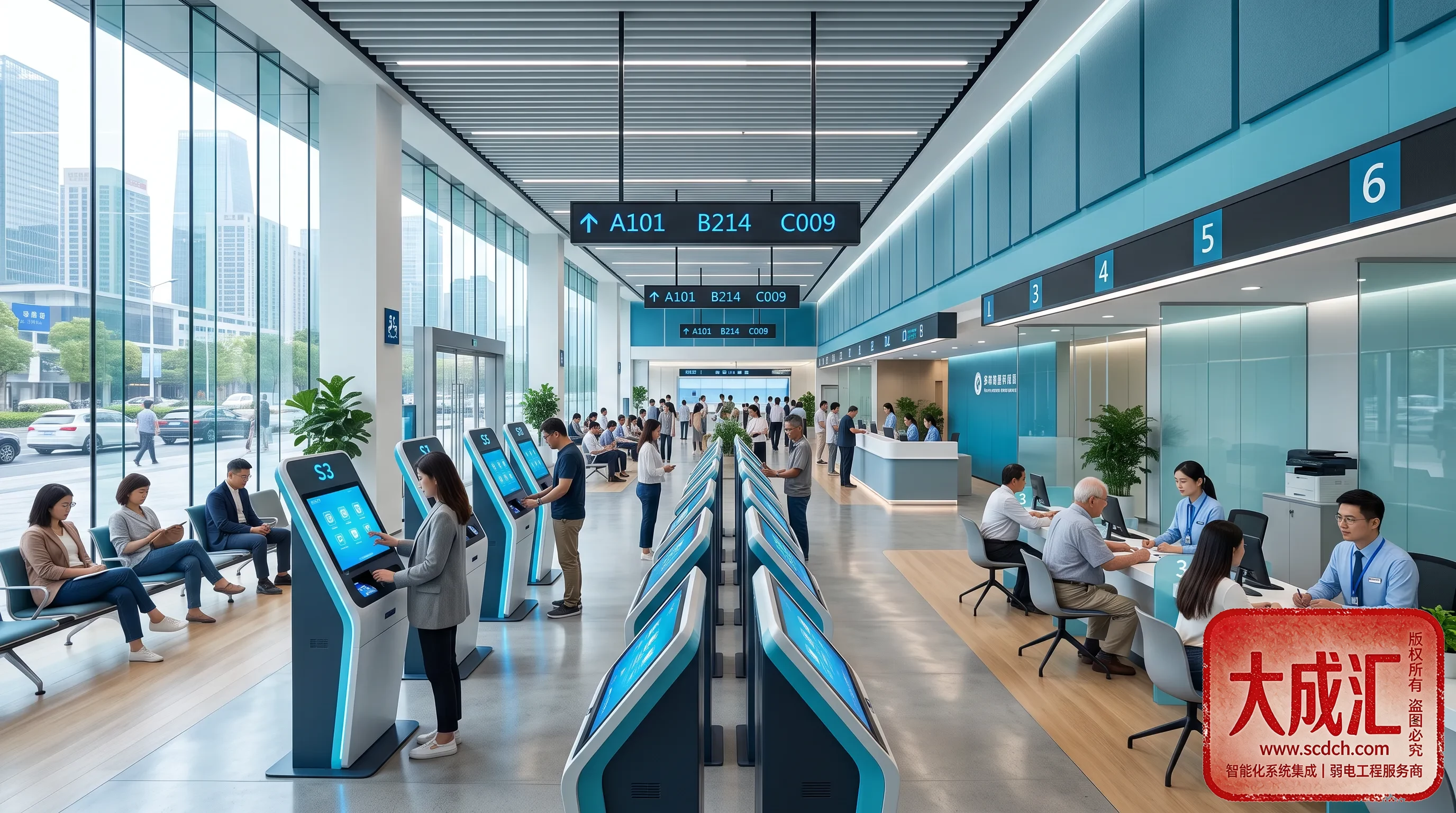
A smart service hall is an integrated "offline + online" service system for public service venues such as government service centers, social security and tax offices, combining smart queuing and calling, self-service terminals, AI-guided consultation and a data hub. With over 10 years of experience in intelligent system integration, Sichuan DCH Technology (DCH) delivers full-lifecycle projects from solution design, weak-current construction and system deployment to O&M support, helping people "enter one door and get everything done," and helping the hall "manage clearly, queue smoothly, serve fast and evaluate truthfully."
1. Background and Value
As government services push toward "one-stop online processing," citizens demand better service experiences — both online and offline. Traditional halls commonly suffer from queuing by shouting, forms filled by hand, consultation only at counters and data that cannot be connected, hurting citizen experience and pressuring counters.
For hall operators, the smart service hall builds a perceivable, dispatchable and evaluable digital service environment:
- Better experience: Visualized ticket-taking, calling and guidance — less queuing and waiting;
- Cost and efficiency: Self-service terminals offload high-frequency items, counters focus on complex work, and staffing is used better;
- Data connectivity: Interfaces with the government data hub reduce repeated form filling and duplicate submissions;
- Refined management: Real-time aggregation of case data shows counter load, processing time and evaluations on one screen.
2. Overall Architecture: Three Platforms and One Hub
DCH breaks the smart service hall into a three-layer "interaction–business–data" architecture plus an operations hub running throughout, ensuring device reliability and system-level linkage:
| Layer | Components | Key Capabilities |
|---|---|---|
| Interaction layer | Queuing/calling screens, self-service terminals, AI guidance terminals, dual counter screens | Ticket taking/calling, self-service, smart guidance, evaluation feedback |
| Business layer | Queuing/calling platform, self-service platform, appointment/ticket interfaces | Business dispatch, number management, counter linkage, timeout reminders |
| Data layer | Data hub and "one-stop online" interface, case registers | Data connectivity, unified identity, material reuse, statistical analysis |
| Operations hub | Hall management dashboard, O&M alerts, evaluation analysis | Real-time monitoring, anomaly response, service closed loop, continuous improvement |
All subsystems converge through a unified platform; managers view ticket volumes, counter load and case progress on one large screen, turning scattered "devices" into a coordinated "system."
3. Core Subsystems
3.1 Smart Queuing and Calling System
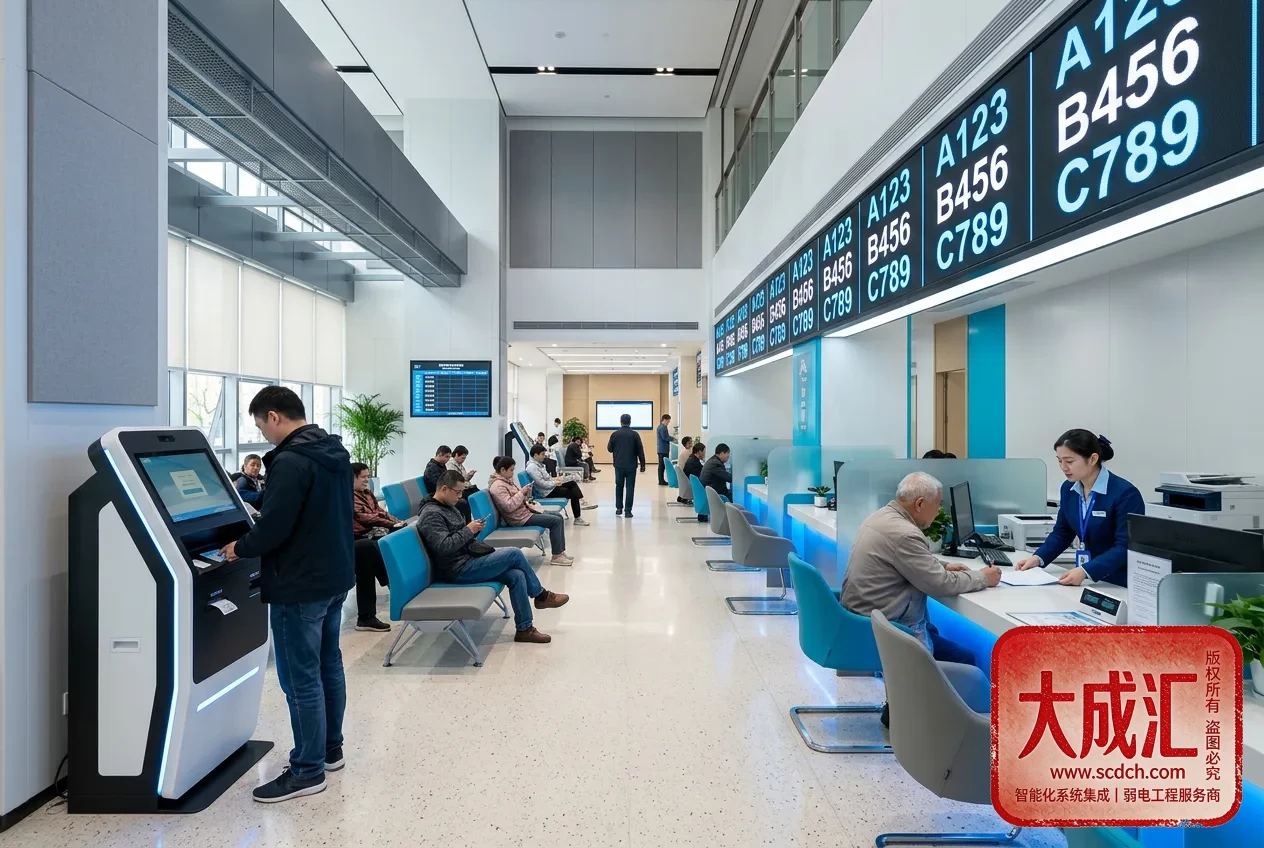
Following the "appointment–ticketing–calling–evaluation" flow, the system supports integrated online/offline ticketing: online appointments get priority when due; offline users take tickets via self-service machines or QR codes. Calling rules are flexibly configured by counter type and business category, supporting VIP priority, re-queue after missing, timeout reminders and parallel calling across counters. Calling information is pushed in real time to large screens, counter sub-screens and mobile phones, so citizens can track progress from their seats instead of crowding the counter.
3.2 Self-Service Terminals
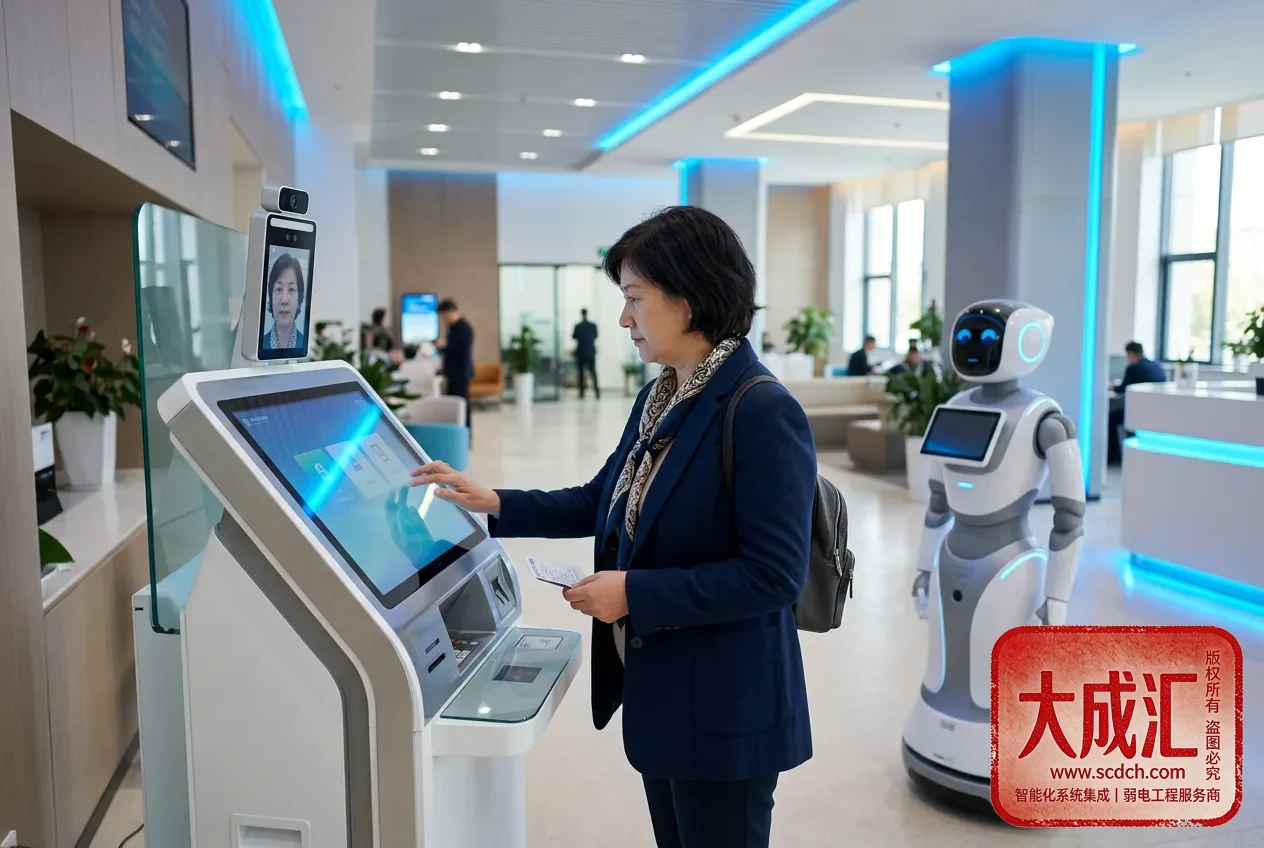
Self-service terminals are deployed for high-frequency, standardized items, supporting certificate printing, self-service inquiry, document upload and payment processing. Some terminals integrate ID reading, facial recognition and electronic signature. Linked with calling and case systems, terminals relieve counter pressure and provide a foundation for 7×24 non-stop service.
3.3 AI Guidance and Intelligent Consultation
AI guidance terminals and intelligent consultation are deployed at entrances and core circulation paths: when a citizen says or types what they need, the system recognizes the business, recommends the right counter and guides the processing route. Common questions are answered immediately in Q&A form; complex issues are seamlessly transferred to human staff. Guidance data connects with the queuing system to direct citizens to the right counter at the right time, reducing ineffective waiting.
3.4 Data Hub and "One-Stop Online" Interface
Through the data hub and government service platform interface, the system achieves unified identity authentication, interoperable case progress and shared material reuse. Materials submitted at self-service terminals or counters need not be resubmitted for subsequent items. Data from online appointments, offline processing and post-service evaluations is collected from the same source, providing authentic evidence for hall operations analysis.
3.5 Service Evaluation and Feedback System
Each case step provides SMS, QR code and terminal evaluation entries, with data aggregated to the operations hub in real time. By linking "good/bad reviews" with case details, supervising authorities quickly locate service shortcomings and track rectification, forming an "acceptance–processing–evaluation–improvement" service closed loop.
4. Typical Application Scenarios
- Government service centers: Ticketing/calling, self-service application and "one-stop online" counter linkage for comprehensive halls;
- Social security / medical insurance halls: High-frequency inquiry and printing automated; counters focus on complex issues;
- Tax halls: Self-service tax terminals with calling diversion reduce peak queuing;
- Parks / community services: Small integrated service scenarios for Party-mass service centers and convenience service stations.
5. Compliance and Standards
The smart service hall must align with national and industry standards; DCH implements them from design through acceptance:
- Requirements of "one-stop online processing" and the national integrated government service platform;
- GB 50314 Standard for Design of Intelligent Building and related intelligent building codes;
- Classified protection of information security (MLPS) and data security compliance requirements;
- Compliance with the Personal Information Protection Law for identity verification and biometric data;
- Accessibility and age-friendly service construction requirements.
6. Why Choose DCH
As a local service provider with over 10 years of expertise in intelligent system integration, DCH delivers differentiated capabilities in service hall projects:
- Full-stack integration: Weak-current works, queuing/calling, self-service terminals and data interfaces are designed from one source, avoiding multi-vendor disputes;
- Full-lifecycle service: From solution consulting, detailed design, construction and commissioning to training and O&M;
- Data compliance: Familiar with MLPS and personal information protection; identity verification and data flows are fully compliant;
- Local response: Rapid on-site support across Sichuan and Southwest China;
- Proven cases: Serving many government/enterprise, university and public institutions with reusable delivery experience.
Together we achieve greatness and pool excellence. Guided by the philosophy of "innovation, integrity, professionalism and collaboration," DCH turns every service hall into a warm, efficient space where citizens find it easy to do business, staff find it easy to work and managers find it easy to run.
7. Construction Essentials and Common Considerations
- Traffic flow planning: Zone ticket-taking, waiting, self-service and counter areas by traffic and business type to reduce crossing;
- Online-offline integration: Full linkage of appointment, ticketing, calling and evaluation; online appointments prioritized when due, offline QR ticketing on the spot;
- Self-service vs. human complementarity: Guide high-frequency standardized items to self-service while retaining human counters for complex issues — no "one-size-fits-all";
- Data connectivity: Unified identity and material reuse via the government hub reduce duplicate filling and submission;
- Age-friendly design: Large fonts, voice guidance and human fallback accommodate elderly users;
- Evaluation closed loop: Evaluation data linked to case details with trackable rectification for continuous improvement.
8. FAQ
Q1: Does building a smart service hall require major business process changes?
No overhaul is needed. DCH uses a loosely coupled layered architecture; subsystems such as queuing/calling and self-service can go live independently, then gradually interface with the government hub in phases.
Q2: What business can self-service terminals handle?
All high-frequency standardized items can move to self-service — certificate printing, self-service inquiry, document upload, payment processing, etc. Items requiring complex review remain at human counters.
Q3: Does the queuing system support online appointments?
Yes. It can interface with government apps, mini-programs or official accounts for online appointment ticketing, with priority calling when due and unified online/offline number management.
Q4: How is citizen identity and material data secured?
In line with the Personal Information Protection Law and MLPS, identity verification data is encrypted and minimally used; interfaces to the government hub use dedicated or encrypted channels with full audit trails.
For detailed solution design or on-site survey tailored to a specific hall scale, please contact the DCH intelligent system integration team for free preliminary consulting and traffic flow planning.